Main menu

  • Home
  • Content
    • Current
    • Archive
  • Info for
    • Authors
    • Advertisers
    • Permissions
  • About Us
    • ISHRS
    • Forum
    • Editorial Board
  • More
    • Alerts
    • Feedback
  • Other Useful Sites
    • ISHRS

User menu

  • My alerts
  • Log in

Search

  • Advanced search
Hair Transplant Forum International
  • Other Useful Sites
    • ISHRS
  • My alerts
  • Log in
Hair Transplant Forum International

Advanced Search

  • Home
  • Content
    • Current
    • Archive
  • Info for
    • Authors
    • Advertisers
    • Permissions
  • About Us
    • ISHRS
    • Forum
    • Editorial Board
  • More
    • Alerts
    • Feedback
  • Follow ISHRS on Twitter
  • Visit ISHRS on Facebook
  • Follow ISHRS on LinkedIn
  • Follow ISHRS on Instagram
  • Follow ISHRS on YouTube
Research ArticleArticles

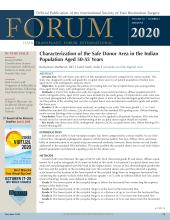
Characterization of the Safe Donor Area in the Indian Population Aged 50-55 Years

Kumaresan Muthuvel
Hair Transplant Forum International May 2020, 30 (3) 73-79; DOI: https://doi.org/10.33589/30.3.73
Kumaresan Muthuvel
Tamil Nadu, India,
MD
  • Find this author on Google Scholar
  • Find this author on PubMed
  • Search for this author on this site
  • For correspondence: cutisskincareclinic{at}gmail.com
  • Article
  • Figures & Data
  • Info & Metrics
  • PDF
Loading

Abstract

Introduction: The safe donor area (SDA) in hair transplants has been categorized in various studies. This study was designed to profile and grade the occipital donor area in our patient population of Indian men, aged 50-55, with androgenetic alopecia (AGA).

Objective: To profile and grade the pattern of receding hair over the occipital donor area among Indian men, aged 50-55 years, with androgenetic alopecia.

Methods: A total of 681 Indian men with AGA (grade Norwood III and above, diffuse unpatterned AGA and/or retrograde AGA), aged 50-55 years, were included in the study group. Occipital donor areas were analyzed and photographed with the head in the sagittal plane. A team of two dermatologists graded the hair loss and the pattern of the receding hair over the occipital donor area and devised a method to grade and profile the donor area.

Results: Of the occipital donor areas analyzed, according to our scale, 78% were graded 1, 2, or 3 and fulfilled the standard SDA criteria; 22% did not fit well into the standard SDA grading scale. Diffuse thinning and/or reverse thinning of the occipital donor area were also observed.

Conclusion: There is no clear-cut defined SDA that can be applied to all patients; therefore, SDA selection should always be conservative and overharvesting of the occipital donor region should be avoided.

  • safe donor area (SDA)
  • androgenetic alopecia (AGA)
  • occipital donor area
  • diffuse thinning (DT)
  • reverse thinning (RT)
  • Copyright © 2020 by the International Society of Hair Restoration Surgery
View Full Text

This article requires a subscription to view the full text. If you have a subscription you may use the login form below to view the article.

Log in using your username and password

Forgot your user name or password?
PreviousNext
Back to top

In this issue

International Society of Hair Restoration Surgery: 30 (3)
Hair Transplant Forum International
Vol. 30, Issue 3
May/June 2020
  • Complete Issue (PDF)
  • Table of Contents
  • Table of Contents (PDF)
  • Index by author
  • Back Matter (PDF)
  • Complete Issue (PDF)
  • Front Matter (PDF)
Print
Download PDF
Article Alerts
Sign In to Email Alerts with your Email Address
Email Article

Thank you for your interest in spreading the word on Hair Transplant Forum International.

NOTE: We only request your email address so that the person you are recommending the page to knows that you wanted them to see it, and that it is not junk mail. We do not capture any email address.

Enter multiple addresses on separate lines or separate them with commas.
Characterization of the Safe Donor Area in the Indian Population Aged 50-55 Years
(Your Name) has sent you a message from Hair Transplant Forum International
(Your Name) thought you would like to see the Hair Transplant Forum International web site.
CAPTCHA
This question is for testing whether or not you are a human visitor and to prevent automated spam submissions.
3 + 11 =
Solve this simple math problem and enter the result. E.g. for 1+3, enter 4.
Citation Tools
Characterization of the Safe Donor Area in the Indian Population Aged 50-55 Years
Kumaresan Muthuvel
Hair Transplant Forum International May 2020, 30 (3) 73-79; DOI: 10.33589/30.3.73

Citation Manager Formats

  • BibTeX
  • Bookends
  • EasyBib
  • EndNote (tagged)
  • EndNote 8 (xml)
  • Medlars
  • Mendeley
  • Papers
  • RefWorks Tagged
  • Ref Manager
  • RIS
  • Zotero
Share
Characterization of the Safe Donor Area in the Indian Population Aged 50-55 Years
Kumaresan Muthuvel
Hair Transplant Forum International May 2020, 30 (3) 73-79; DOI: 10.33589/30.3.73
del.icio.us logo Twitter logo Facebook logo Mendeley logo
  • Tweet Widget
  • Facebook Like
  • Google Plus One

Jump to section

  • Article
    • Abstract
    • INTRODUCTION
    • METHODS
    • RESULTS
    • DISCUSSION
    • CONCLUSION
    • References
  • Figures & Data
  • Info & Metrics
  • PDF

Related Articles

  • No related articles found.
  • Google Scholar

Cited By...

  • No citing articles found.
  • Google Scholar

More in this TOC Section

  • Co-Editors’ Messages
  • Glycemic Thresholds for Hair Transplantation: An Evidence-Informed Framework for Follicular Unit Excision
  • Message from the ISHRS 2026 World Congress Program Chair
Show more Articles

Similar Articles

Keywords

  • safe donor area (SDA)
  • androgenetic alopecia (AGA)
  • occipital donor area
  • diffuse thinning (DT)
  • reverse thinning (RT)

Navigate

  • Home
  • Current
  • Archives

General Information

  • Authors
  • Advertisers
  • Permissions

About

  • ISHRS
  • Forum
  • Editorial Board

Follow Us On

  • Twitter
  • Facebook
  • LinkedIn
  • Instagram
  • YouTube

© 2026 Hair Transplant Forum International

Powered by HighWire